
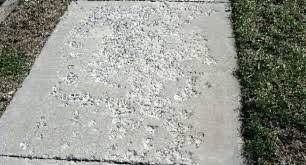
As the latest winter storm approaches, this is a good time to review how traditional de‑icing salts can quietly but seriously damage your concrete sidewalks, steps, and drive areas like in this photo.
Concrete is extremely hard, but it is also highly porous. It absorbs water into tiny pores throughout the surface. When ice and snow are treated with salt, the result is a salty slush that sits on top of the concrete. Because saltwater is heavier than fresh water, it sinks deeper into those pores and actually increases the amount of water held within the concrete.
De‑icing salts lower the freezing point of water from 32°F down to roughly 27°F. That works in your favor until the temperature falls below that point. Once it gets colder than about 27°F, the saltwater trapped in the concrete begins to freeze and form ice crystals. When water freezes, it expands by up to 9% in volume. Inside the concrete, that expansion creates internal pressure that the surface layer cannot relieve.
The path of least resistance is outward and upward, which is why the early stages of salt damage appear as small, cone‑shaped pits or craters popping up on the surface. Over time, repeated use of salt and repeated freeze–thaw cycles will cause more extensive scaling and flaking. Eventually, the entire top layer of concrete can be destroyed, exposing the rock aggregate and significantly reducing the life and appearance of the slab.
If you look closely at most de‑icing salt containers, you will notice a warning that says not to use the product on concrete. That language is there for a reason. When selecting de‑icers, it pays to read the label carefully and look for products designed to be safer for concrete and to work at lower temperatures. As an alternative, non‑corrosive traction materials such as sand or even bird seed can improve safety on walkways without the same level of surface damage risk.
For our typical winter conditions, where temperatures can drop as low as 5°F, it is especially important to choose products that work in very cold weather but are still more concrete‑friendly than traditional rock salt. A practical approach is:
-
Use calcium chloride as the primary de‑icer, since it remains effective well below 5°F, which allows you to use less product and reduce refreezing.
-
Use magnesium chloride as a secondary option, as it is generally effective down to around 0°F and is often marketed as gentler on concrete and landscaping when used sparingly.
-
Reserve concrete‑safe products such as calcium magnesium acetate (CMA) for milder cold spells (typically above about 20°F) or as part of a blended product, as they are very surface‑friendly but less effective in extreme cold.
-
In all conditions, combine limited use of these de‑icers with non‑chemical traction materials such as sand or fine gravel on walkways, which provide grip without chemically attacking the concrete.
Visit our Concrete page for more information about properly maintaining concrete surfaces.